 Regulated firm
Japanese Knotweed: the surveyor’s guide for buyers
Japanese knotweed (Reynoutria japonica) is one of the most invasive plants in the UK, and one of the few property defects that can stop a mortgage in its tracks. Lenders have specific requirements where knotweed is identified on or near a property, and buyers can face real difficulty securing finance until a professional management plan is in place.
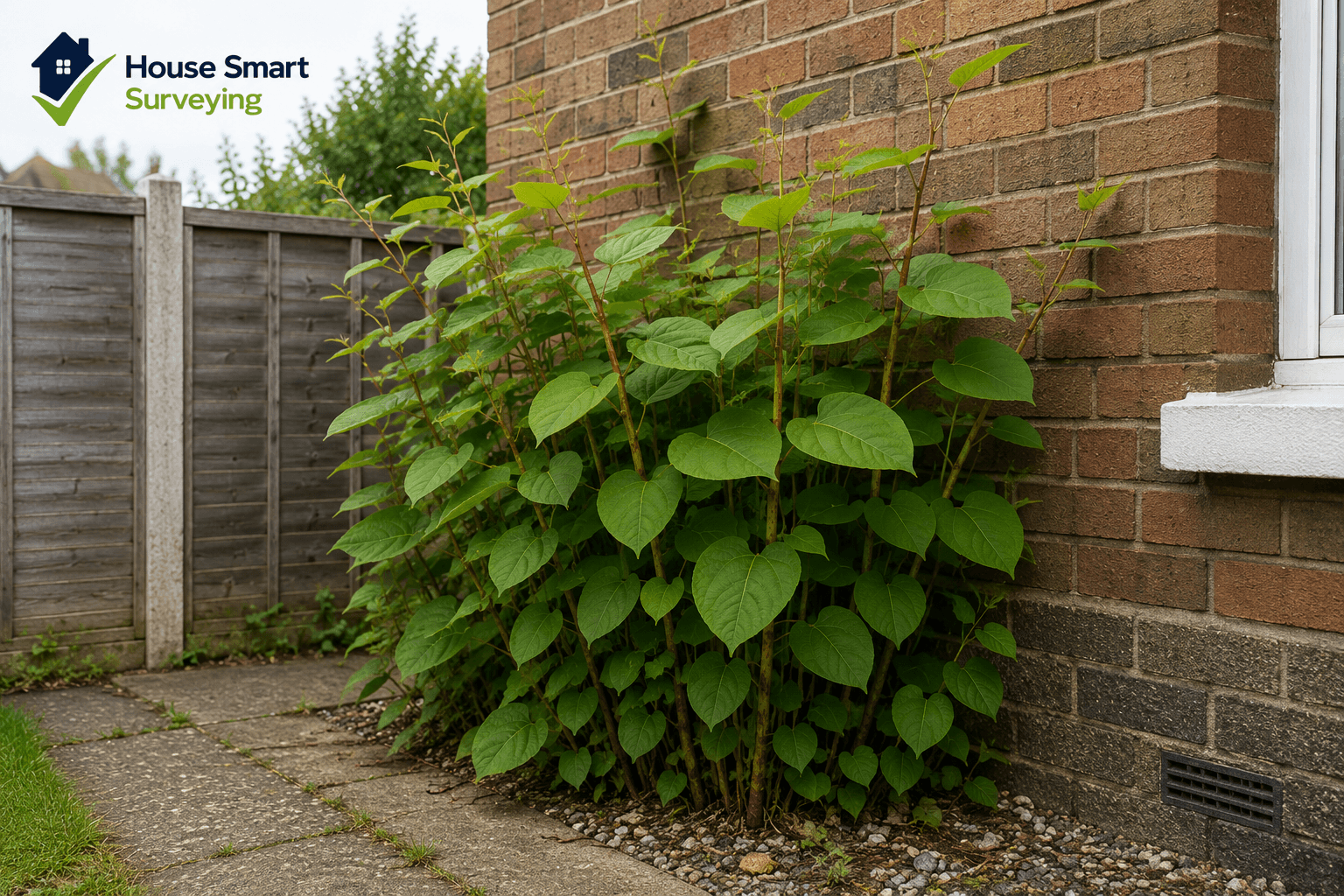
The plant spreads through underground rhizomes that can extend up to three metres deep and seven metres laterally. It can emerge through tarmac, patio paving, concrete slabs and, in severe cases, damage building fabric such as drainage runs and light retaining walls. It dies back in winter, which is exactly why untrained eyes miss it: a dormant crown in January looks like nothing at all.
During a survey we identify knotweed on or near the property, record its proximity to habitable structures, and explain what it means for your purchase, including whether an insurance-backed treatment plan will satisfy your lender. We use the industry-standard RICS four-category risk framework, which is now the format most lenders expect to see.
Under the RICS 2022 knotweed guidance, the presence of knotweed does not automatically preclude a mortgage or make a property unsaleable. What matters is the distance from the building, the management plan in place, and the guarantee behind it. Get those three right and most transactions proceed to completion normally.
If knotweed is within 3 metres of the building, most lenders will require a professional treatment plan with an insurance-backed guarantee before releasing funds. Factor this into your negotiation.
What we look for on site
What lenders actually require
Most UK lenders now follow a similar approach: knotweed on or near the property must be identified in the survey, and a treatment plan with an insurance-backed guarantee (IBG) is generally required for anything within 3 metres of the building. Some lenders will lend on the basis of a signed and funded treatment plan; others require the treatment to be already under way.
The insurance-backed guarantee is the crucial piece. It transfers the treatment risk from the homeowner to a specialist insurer, and it is transferable on future sales. Without an IBG, a knotweed treatment plan is just a promise; with one, it is a bankable warranty.
How treatment works, and what it costs
Chemical treatment using glyphosate-based herbicides is the industry standard for most residential situations. A typical treatment programme runs 2-3 years with quarterly applications, followed by a monitoring period. On a domestic garden, budget £2,500-£5,500 including the IBG.
Excavation and off-site removal is faster (usually a few days) but significantly more expensive (£7,000-£25,000 depending on scale) and only sensible where development is imminent. For most buyers, a chemical treatment plan is the proportionate and lender-acceptable route.
“Ninety per cent of knotweed cases we survey are lower-risk than the buyer feared. The other ten per cent are exactly as bad as they thought. The distinction is worth thousands.”